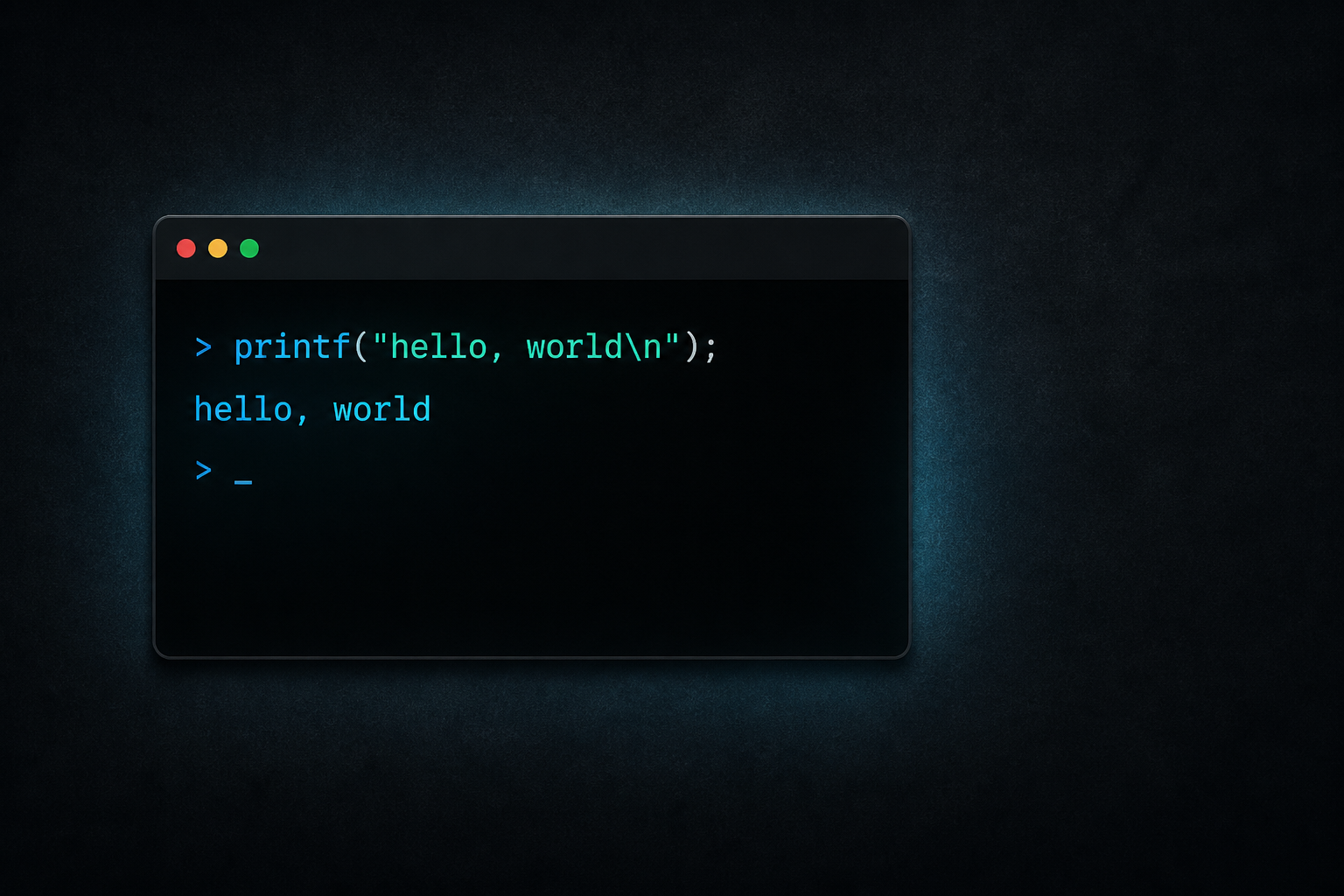
The smallest program that proves the tools work
Programmers still use a tiny program that prints “hello, world” as a first test of a language, a compiler, or a new toolchain. The earliest documented example is Brian Kernighan’s 1972 Bell Labs memo A Tutorial Introduction to the Language B, where an example illustrating external variables printed hello, world! because B stored at most four ASCII characters in a character constant; an earlier example in the same tutorial had printed hi!. Kernighan reused a simpler form in the 1974 internal memo Programming in C: A Tutorial. The version that spread widely is the one in Kernighan and Dennis Ritchie’s 1978 book The C Programming Language, which prints hello, world with a single printf call.
That example became a convention: a minimal program that checks that source can be compiled or run and that the operator knows how to invoke the tools. It is used both as a teaching device and as a sanity check. Claims that the computing phrase began in BCPL appear in the Jargon File; they are not as firmly documented as Kernighan’s B and C examples, so this piece does not treat them as established origin. The same small test is still a useful first run when a publishing pipeline is new: if the greeting comes through clean, the rest of the stack is more likely to be wired correctly.