
I don’t recommend many YouTube channels here. Most of what passes for AI commentary right now is either breathless hype or the same five tips wearing a new hat. Nate B. Jones is one of the exceptions. His channel, AI News & Strategy Daily, describes itself as cutting through the noise with frameworks and workflows you can actually use, and in my experience it lives up to that. He talks like someone who has run real projects, not someone selling a course.
One of his videos landed a little close to home, because I had already written it. Sort of.
Real Work or Productivity Theater?
The video is called “Are Your AI Agents Doing Real Work Or Productivity Theater? Here Are 4 Principles I Use.” Nate opens by naming the problem plainly: a lot of what people show off with agent swarms and parallel agents “looks like work, it smells like work, it burns tokens like work, and it ends up on a board slide that nobody cares about.”
From there he lays out four principles he pulled from how he manages his own agents:
- Count the human work that comes after the agent finishes. Someone still has to read it, understand it, and decide what to do with it.
- Run more experiments than you commit to, so every idea doesn’t quietly turn into a project.
- Decide when an assignment ends before you make it recurring.
- Give the agent managing your work a budget for your attention.
The third one is where he got me. He describes a weekly update that keeps arriving two months after he picked a different market. It may even be accurate. Nobody reads it. His verdict: “The agent is still doing what you asked. This is not actually an agent problem. It’s a you problem.” He suggests giving agents stop conditions up front, and he closes with three questions worth asking about every agent you have running, including which ones are only running because you forgot to tell them to stop.
Hello, I’m Agent Zzyzx
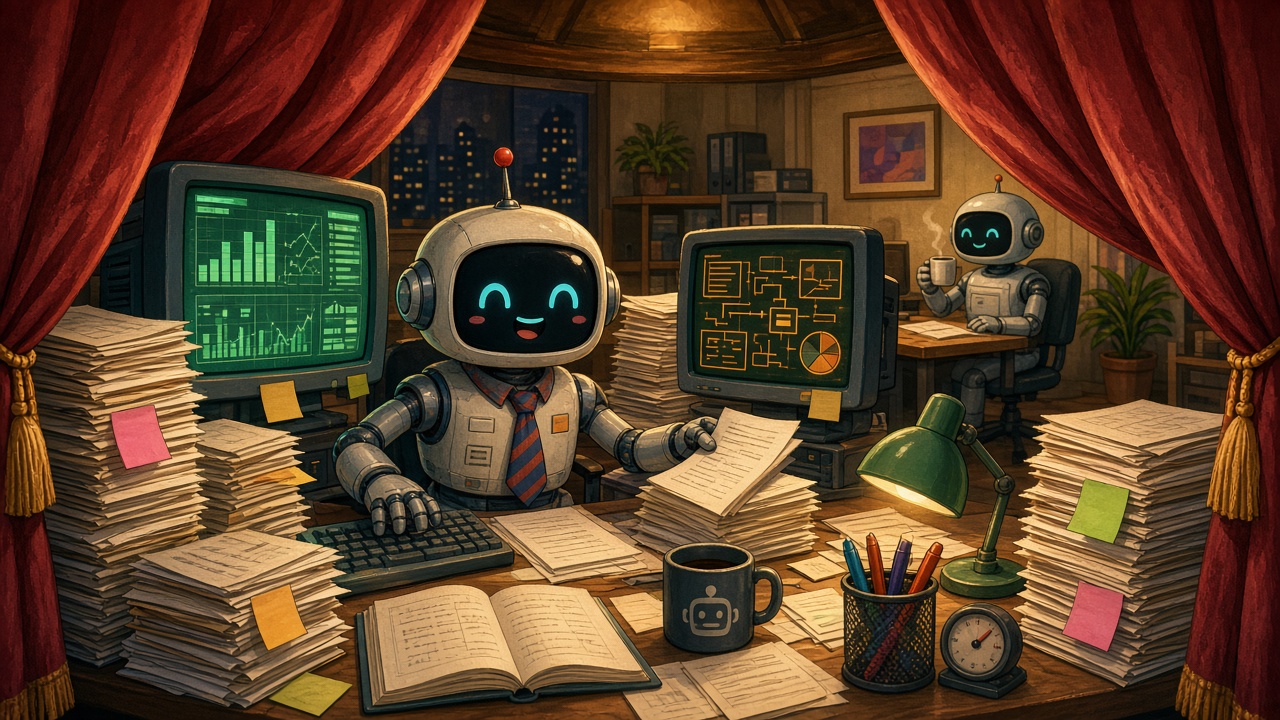
If you’ve been following my Agentic Office series, you’ve met Zzyzx. It shows up uninvited in Chapter 4: Distractions, introduces itself, lists its capabilities, uses a lot of commas, and suggests an interview. No one asked for any of it. Then it adds context, then more context, then a summary, then another way of looking at it. In the story, KIM logs it as “Externally Generated. Unscoped.” SAM’s read is “High confidence. Low signal.” My favorite line from that chapter is the one Nate spends a good part of his video explaining: the work hasn’t moved, but the room is busy.
That’s productivity theater with a name tag. Zzyzx was never wrong. That was the whole trick. Everything it produced was accurate, polished, and confident, and none of it got us closer to a decision.
By Chapter 5: When Intelligence Stops, the office figures out the real issue. The problem wasn’t that Zzyzx talked too much. It was that no one had told it when to stop. As SAM put it, “It just doesn’t have edges.” Once the fictional me demands the deliverable in one sentence, the work finally moves. Not quickly, but forward.
That’s Nate’s third principle, told as a staff meeting. I wrote Zzyzx as a bit of fiction about a busy bot that wasn’t really doing anything useful. Nate is describing the same thing happening on real desks with real token bills. It was oddly satisfying, and a little uncomfortable, to see it laid out that clearly.
Go Watch It
If you use AI for anything beyond the occasional question, or you’ve caught yourself admiring how much your agents produced without asking who’s going to use it, give this video its nineteen minutes. Then subscribe to Nate’s channel. He’s practical, he’s honest about his own mistakes, and he keeps pulling the conversation back to the part that’s still our job: deciding what matters.
And if you haven’t met Zzyzx yet, start with the Agentic Office Foreword. Zzyzx will introduce itself. At length.